At Devcon 8 in Mumbai, Alex, Head of R&D at cp0x, addressed a growing contradiction in DeFi: protocols promise open access for everyone, while their official websites block users by location, screen wallets, and impose additional access requirements.
We examined restrictions across official DeFi interfaces and compared them with the principles these projects promoted just a few years ago.
From open finance to restricted access
In 2020, Aave described a financial system accessible to anyone, without geographic barriers. By 2026, its official interface was screening wallets through an AML service, while its terms restricted access from certain jurisdictions and prohibited VPN use.
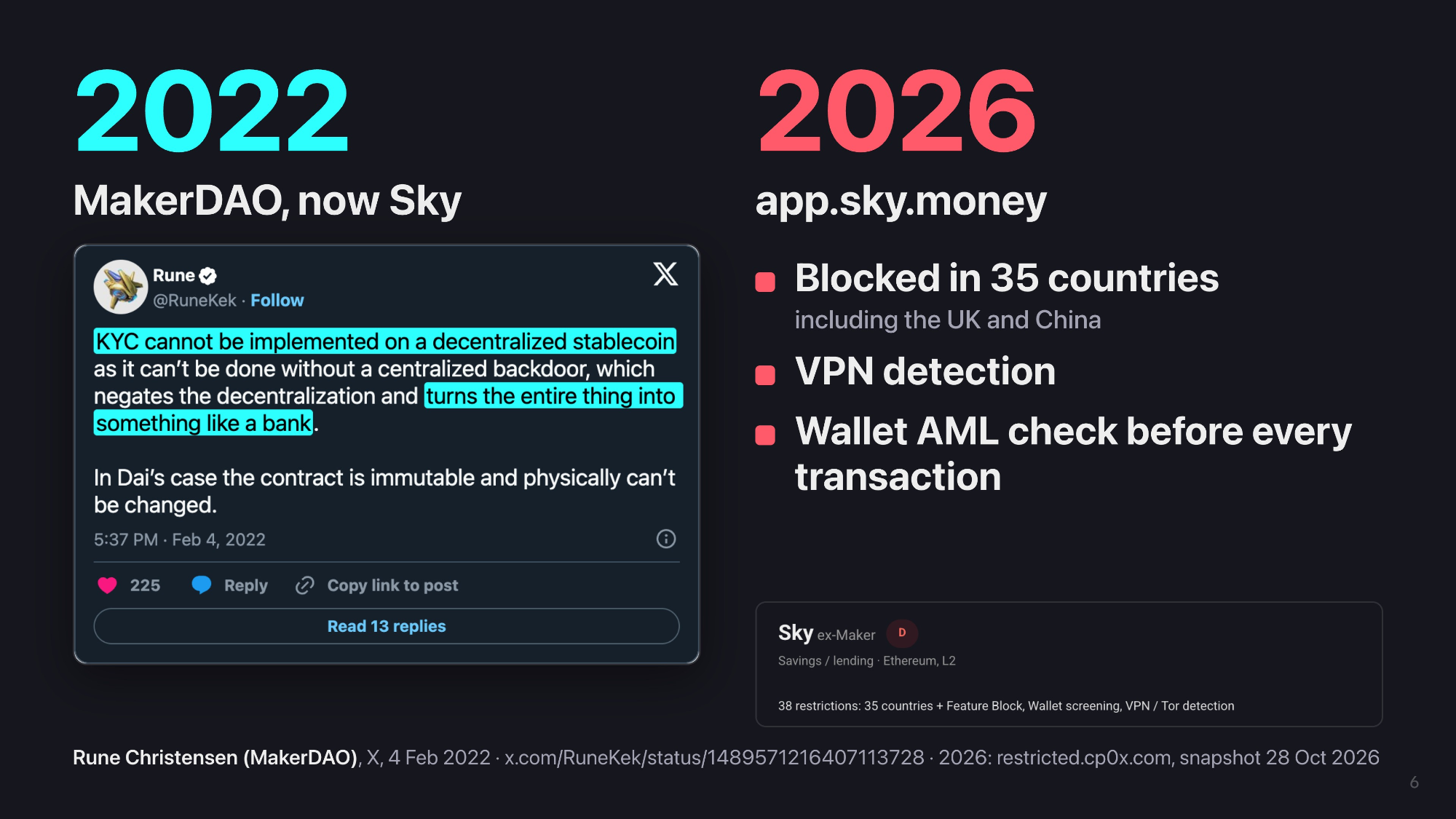
In 2022, MakerDAO founder Rune Christensen warned that introducing KYC into a decentralized stablecoin would create a centralized backdoor and undermine decentralization itself. Yet in October 2026, the Sky app blocked 35 countries, detected VPNs, and performed wallet AML checks.
Other major projects followed a similar path.
Morpho aimed to build an open lending infrastructure, but its official interface began hiding certain markets due to legal restrictions.
Uniswap described decentralized trading as open to anyone, anywhere. Its interface now screens wallets and restricts certain features based on IP addresses.
Hyperliquid promoted trading without intermediaries or gatekeepers. In October 2026, its official interface blocked seven jurisdictions and hid certain markets in 19 countries.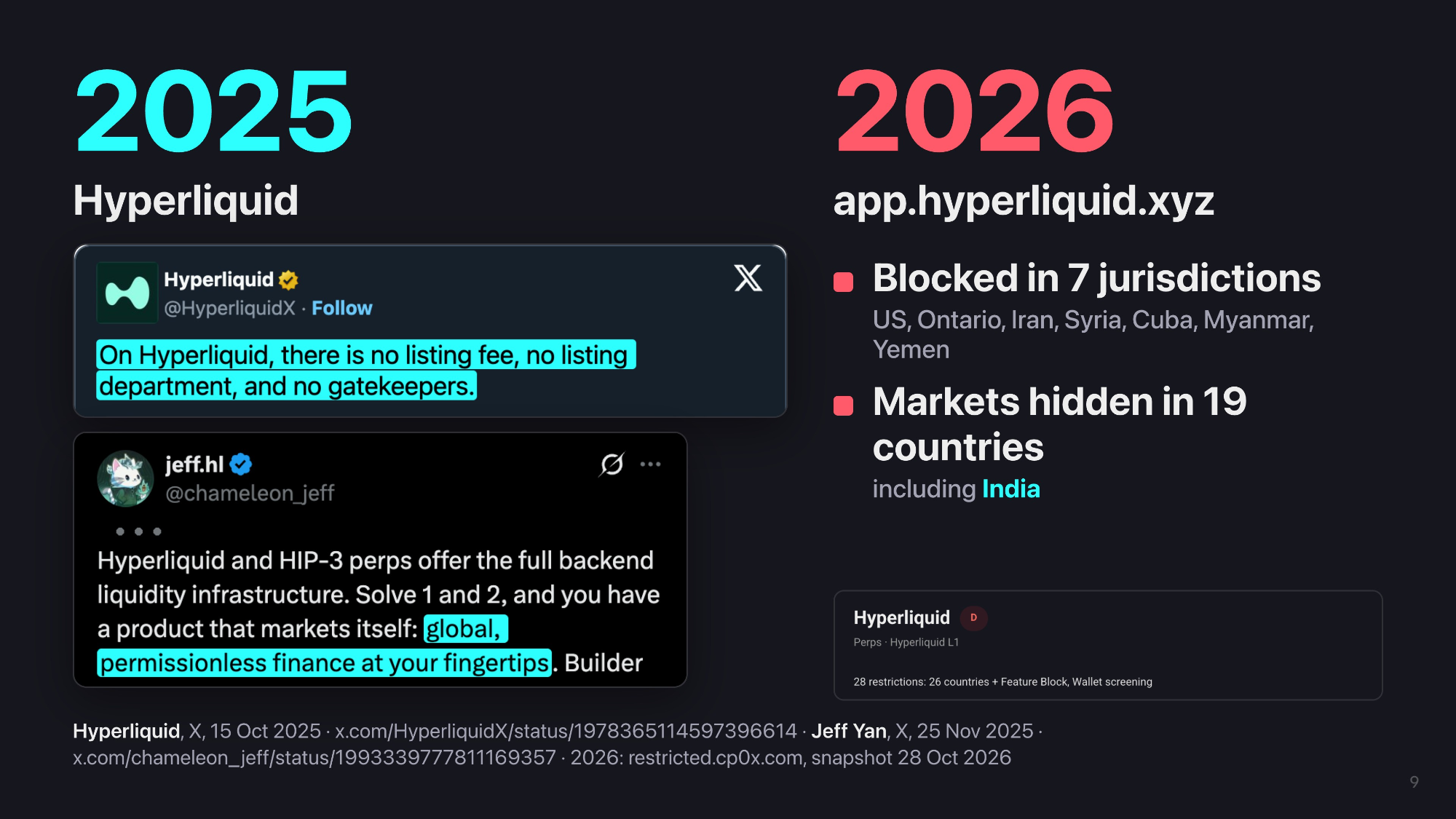
The underlying smart contracts have not necessarily changed. In many cases, restrictions were introduced at the website level, where users access the protocols.
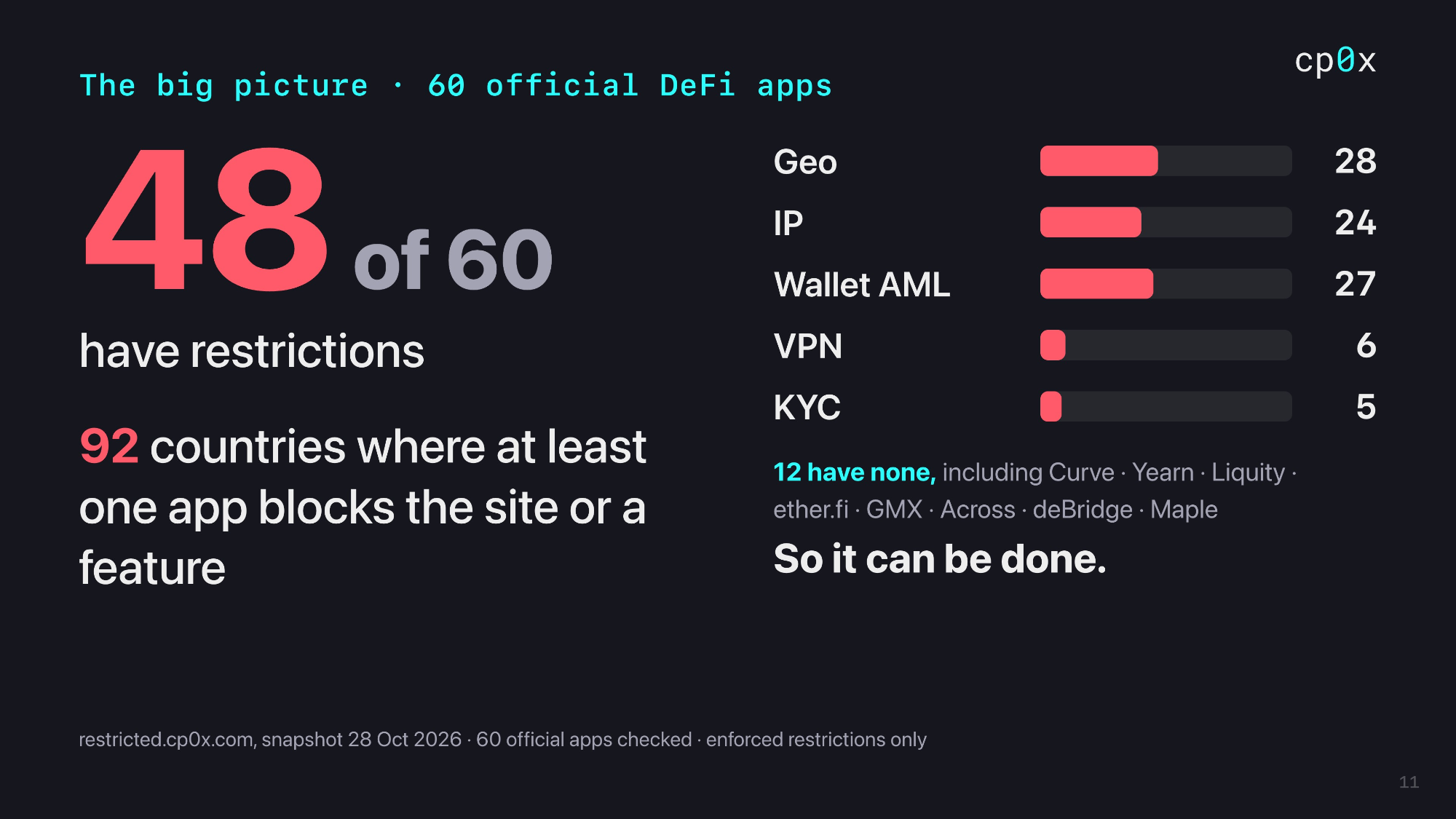
48 of 60 DeFi interfaces restrict access
The cp0x research covered 64 official DeFi interfaces. Technical restrictions could be assessed for 60 of them:
-
48 interfaces enforced at least one restriction.
-
12 had no technical restrictions detected.
-
Four could not be conclusively rated.
The presentation identified five categories of restrictions:
-
Geographic restrictions — 28 interfaces.
-
IP restrictions — 24.
-
Wallet AML screening — 27.
-
VPN detection — 6.
-
KYC — 5.
A single interface can apply several restrictions at once.
Across 92 countries and regions, at least one of the applications studied blocked access to its website or certain features. This does not mean all apps are blocked in those locations, but it shows how widespread access restrictions have become.
Restrictions live in interfaces, not necessarily in contracts
The key distinction is between the protocol itself and its official website.
A user opens a website that may check their IP address, location, or wallet history and refuse access. But the smart contract behind that website may still accept transactions submitted directly.
In the sample, 26 of 27 wallet AML checks were performed off-chain. In other words, these checks were not enforced by the smart contracts themselves.
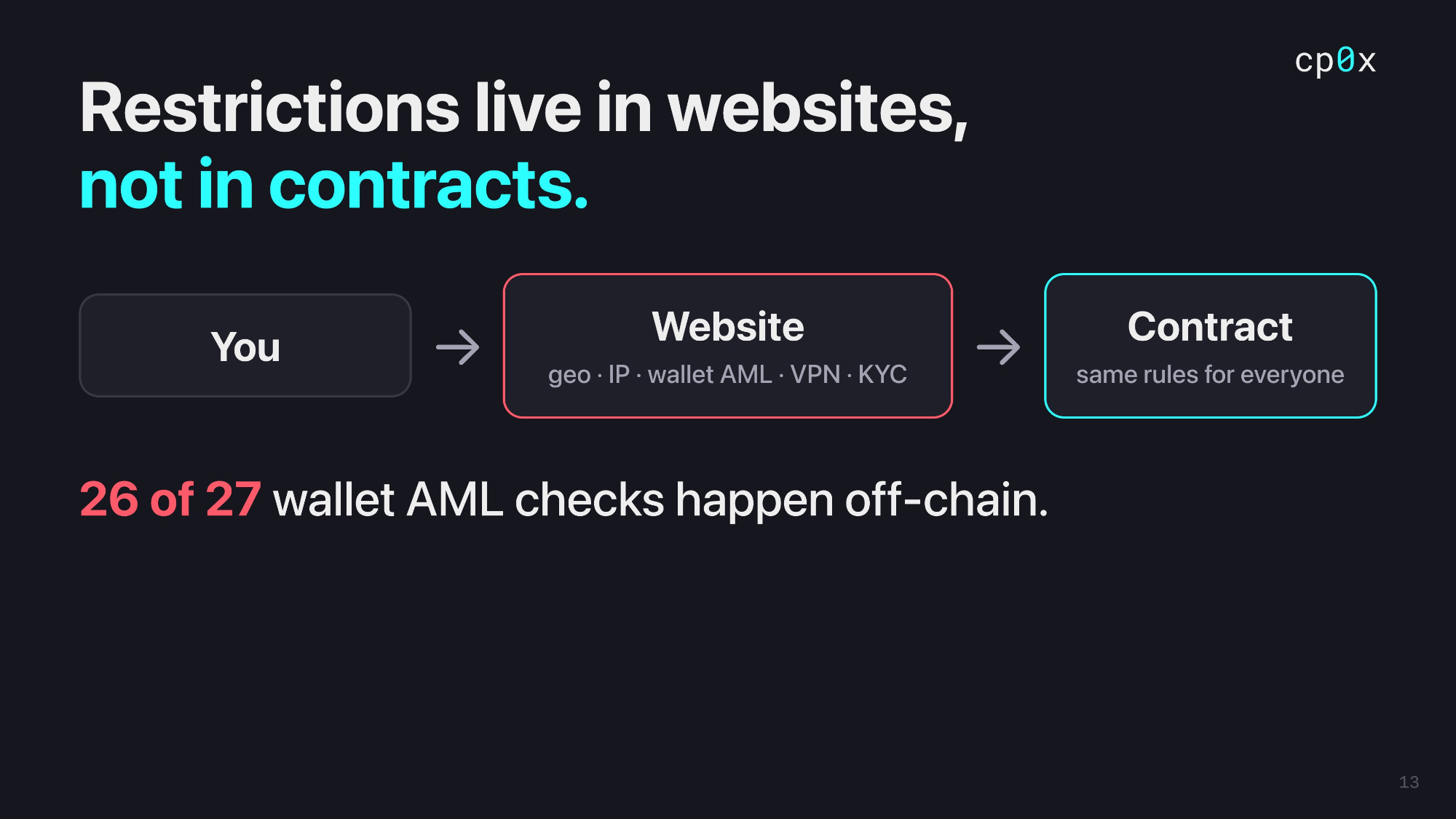
Some protocols do enforce restrictions at the smart-contract level. But being blocked by an official website does not automatically mean that interacting with the underlying protocol is technically impossible.
Who do these restrictions actually stop?
Someone who knows how to interact directly with smart contracts can often bypass the official website entirely.
An ordinary user opens the interface, sees an access restriction, and leaves. They may never realize that the underlying contract is still accessible.
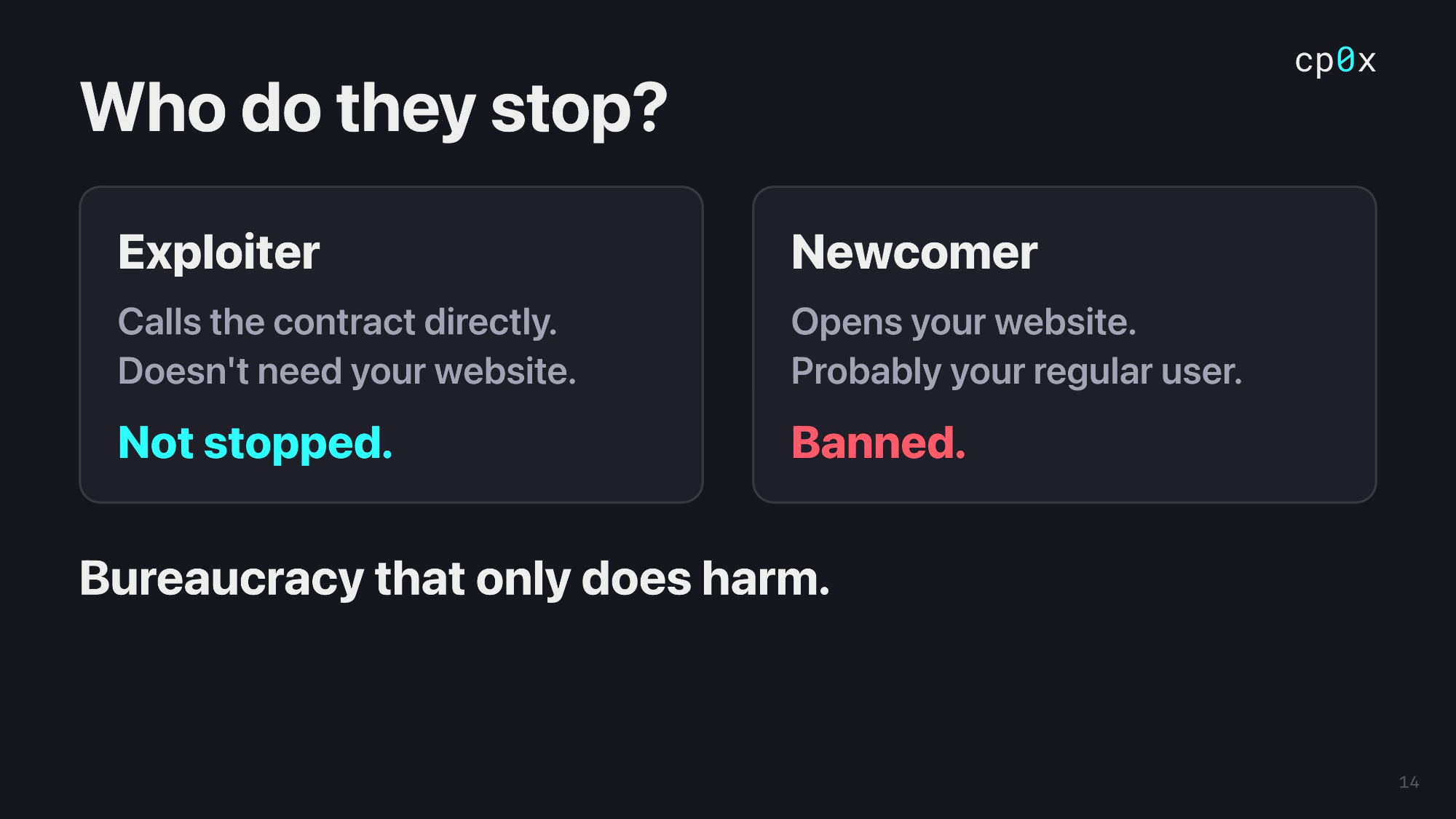
The result is a strange contradiction: restrictions create obstacles for regular users without necessarily stopping technically capable participants who can interact with contracts directly.
Instead of open finance, we get additional barriers and bureaucracy at the interface level.
What can we do?
There is no universal solution. But when a smart contract remains permissionless, users have alternatives:
-
Interact with the contract directly.
-
Build an independent interface, including with AI tools.
-
Publish the code on GitHub so others can inspect, reuse, and self-host it.
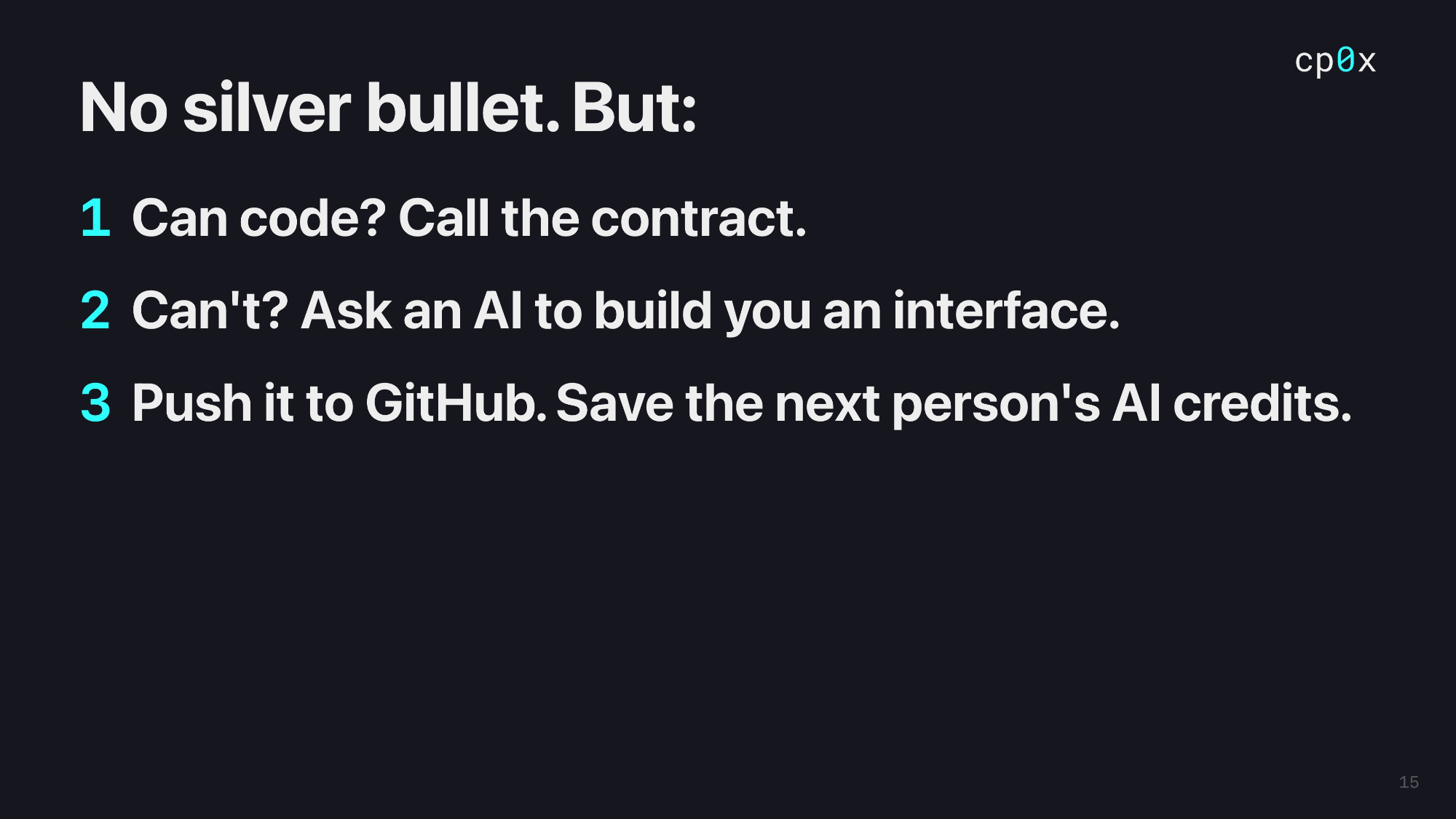
Modern AI tools have made building interfaces much easier. Tasks that once required a development team and months of work can, in some cases, now be completed much faster.
But open-source code matters just as much as access. Users need to be able to verify contract addresses, inspect what the interface does, and make sure no hidden actions are involved.
Why open source matters
At the time of the presentation, 33 of the 60 official interfaces reviewed were closed source.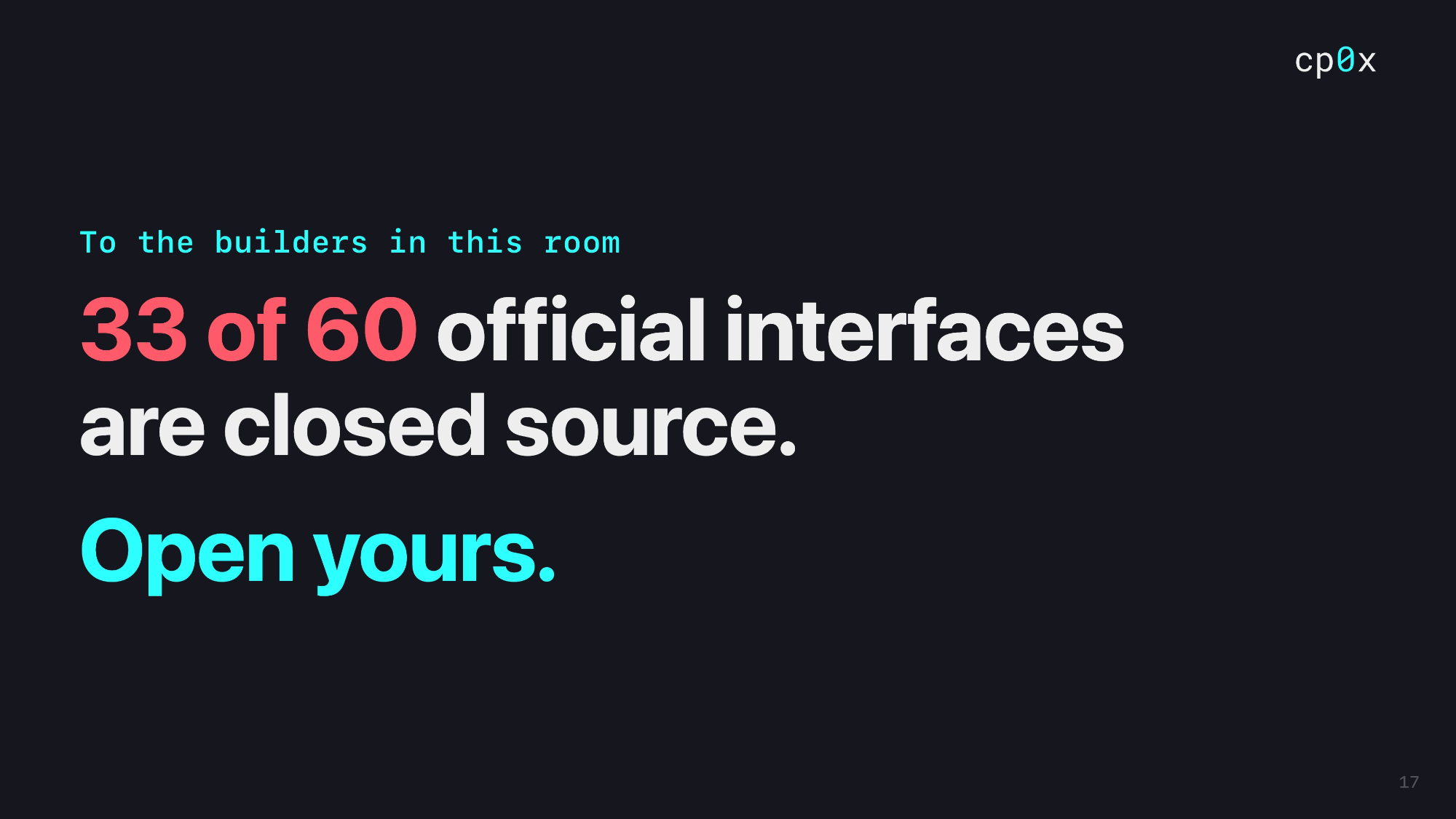
When source code is unavailable, users cannot fully audit how an interface works or independently rebuild it. They have to trust the operator of the official website.
cp0x offers an alternative: open-source interfaces for existing DeFi protocols.
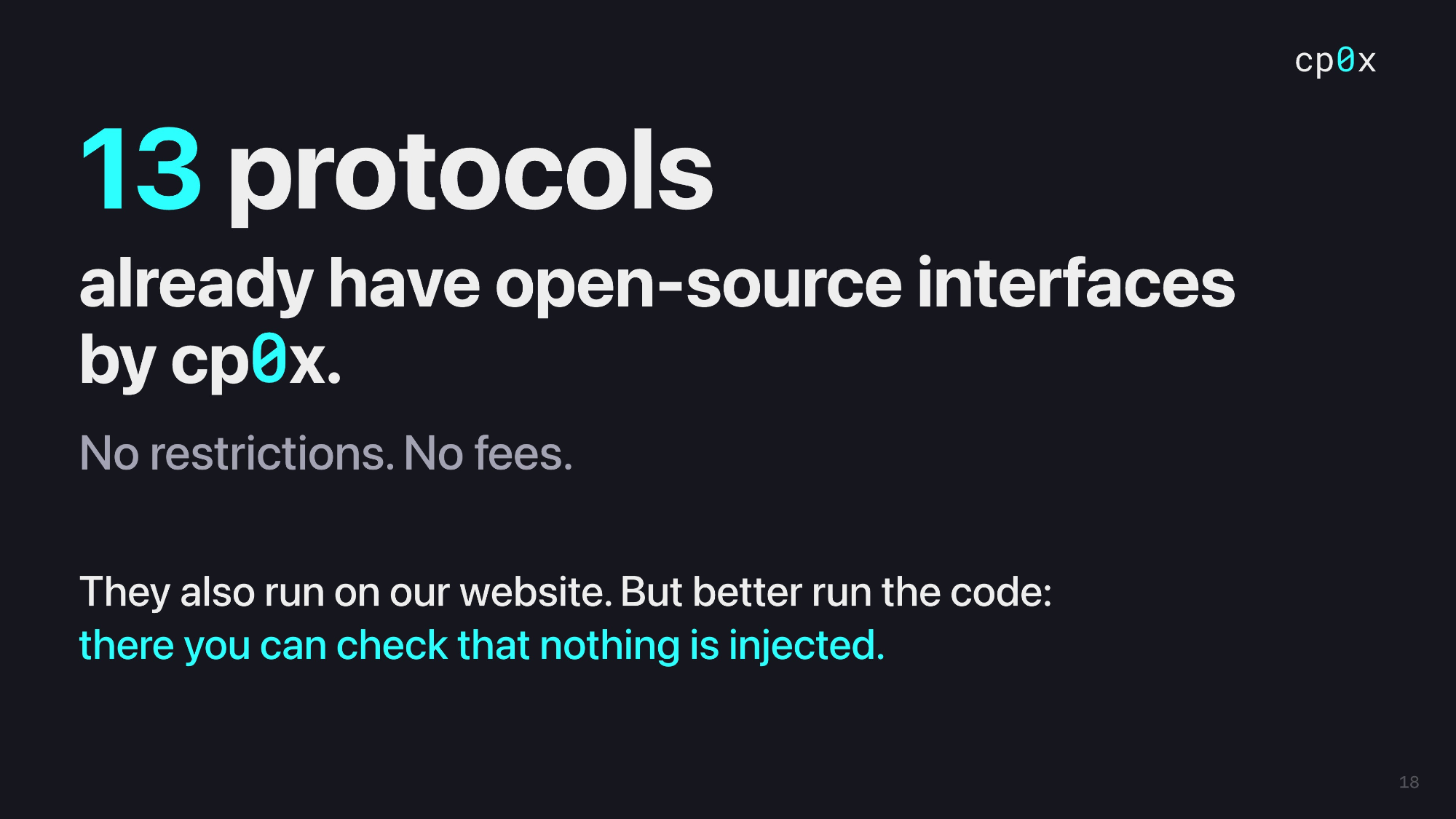
At Devcon 8, we presented the results of this work: interfaces for 13 protocols, without access restrictions or additional interface fees. Users interact with smart contracts through their own wallets. cp0x charges no additional interface fees; network and protocol fees may still apply.
The central message is simple: the product is the smart contract, not the website.
If access to a protocol depends entirely on the operator of its official interface, permissionlessness is only a promise.
Follow your values. Long live cypherpunk!
Presentation, research, and sources
The presentation reflects a snapshot from October 28, 2026. Restrictions, terms of service, and interface availability may change.